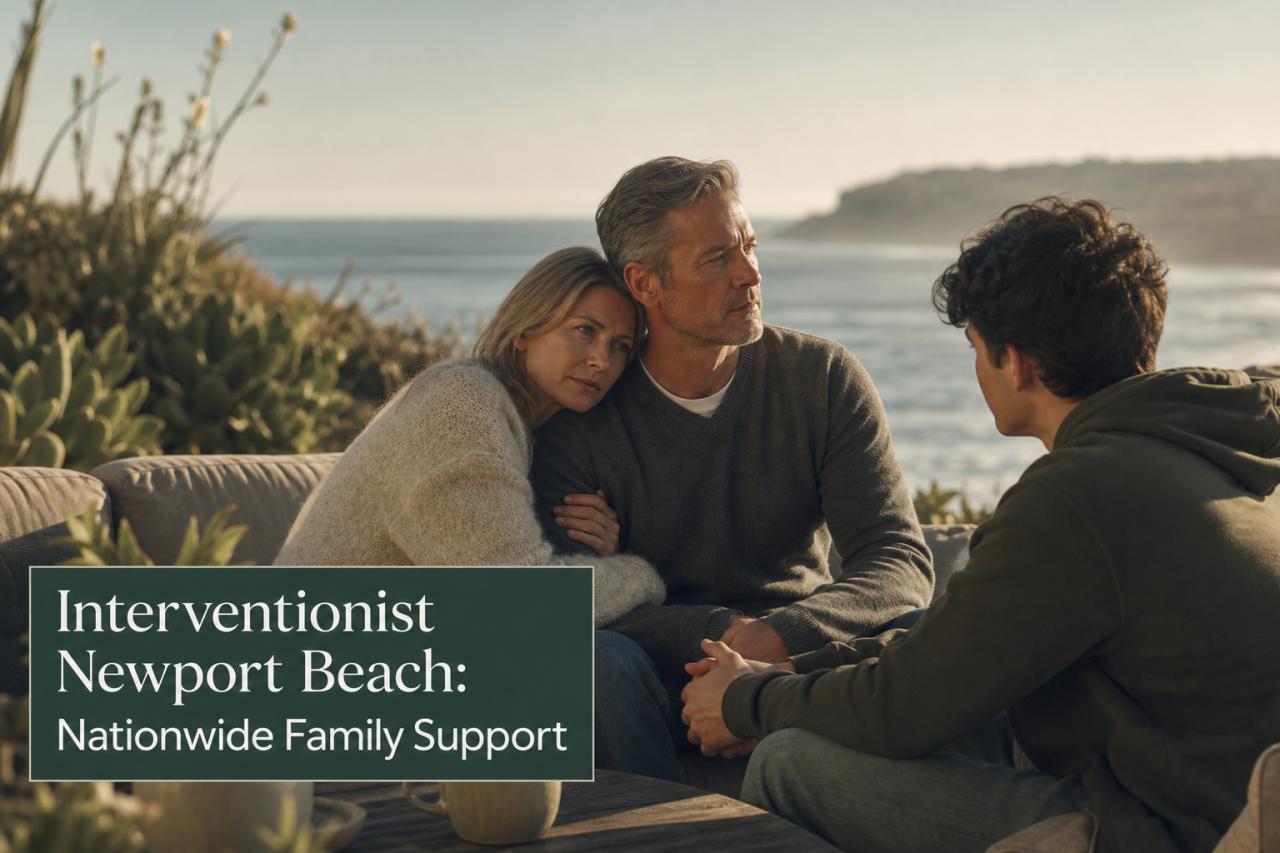
You can hire an interventionist in Newport Beach even if your loved one lives in another state, because our certified team is based here and travels to wherever they are. Addiction Interventions works with families in all 50 states, and the first call is free and confidential. When you dial 949-776-7093, you'll speak with David Gates, our Lead Interventionist, instead of a call center.
If you or someone you love is thinking about suicide or self-harm, call or text 988 any time, day or night. You can also chat with a trained crisis counselor at [988lifeline.org](https://988lifeline.org). If someone is in immediate danger, call 911 right away for emergency help.
Hiring an Interventionist in Newport Beach When Your Family Lives Elsewhere
Our headquarters is at 3822 Campus Dr #300-B in Newport Beach, but the work doesn't happen in our office. Our interventionists travel to your loved one's location, whether that's a home in Ohio or a treatment facility in Florida. You don't need to convince your loved one to fly to California, and you don't need to be in the same city to start planning.
Families often worry that someone from far away won't understand their situation. Distance is actually where a professional's structure helps most. You can work with us by phone from your own city, and we'll build the plan around your loved one's circumstances, your family's history, and the setting for the conversation. We offer in-home and facility-based interventions, so the location can be whichever feels calmest and safest.
David Gates, who leads our team, has personally led more than 1, 500 interventions and is in long-term recovery himself. He's formally trained in the ARISE method, the Johnson Model, and Family Systems Intervention, so he can match the approach to your family rather than forcing one format on every case.
If the situation is moving fast, say so on the first call. We're available around the clock, and our crisis interventions are built for cases where waiting a few weeks isn't realistic.
How an Interventionist Travels to Your Loved One
Once you decide to move forward, we handle the travel logistics, so you won't book a flight or hotel for the interventionist. We choose the location with you, usually your loved one's home or a treatment facility, and a certified interventionist from our network meets your family there on the day of the conversation.
Most of the work happens before anyone travels. During family preparation, we coach you by phone on what to say, what to expect in the room, and how to hold loving but firm boundaries afterward. Your family can be spread across several states and still prepare together, since the coaching doesn't require everyone to sit in one place.
On the day itself, a certified specialist leads a structured, calm conversation. Your role is to say what you've prepared, and the interventionist keeps things steady if emotions rise. The goal is to open the door to treatment, which is why we line up placement options ahead of time instead of scrambling afterward.
We don't leave once the conversation ends. We coordinate treatment placement and follow through with you while your loved one is in care and after, which matters most when you live far away and can't check in person.
If your family is split between states, tell us where each person lives and where your loved one is right now. That tells us whether a home visit or a facility makes more sense, and it lets us plan the timing around the people who need to be present.
What Happens When You Call
The call is a conversation, not an intake script, and nobody asks you to commit to anything. We listen while you explain what's going on with your loved one and how long it's been building. You don't need a diagnosis, a treatment plan, or agreement from the rest of the family before you dial.
Expect a few practical questions. We'll ask where your loved one is, what substances or mental health concerns you're seeing, and whether anything feels urgent today. If a safety risk comes up, we'll tell you plainly what to do first. It helps to jot down the family members who might take part, any past treatment attempts, and what you've already tried saying to your loved one.
From there, we lay out your options in plain terms. Depending on your situation, that might be a structured intervention, a mental health or dual diagnosis intervention, or a crisis response if time is short. You'll hear what each path involves and what the next step would be, and you can hang up with the information and take your time deciding.
Many families ask whether the call costs anything or gets shared. It's free and 100 percent confidential, so you can speak openly about the parts of your family's story that feel hardest to say out loud.
If you decide to go forward, we move into family preparation and build the plan. Costs depend on the scope of the work, and you can see what shapes them on our intervention cost page. If you'd like to talk through your situation with our team before booking anything, you can also reach out through our admissions page.
The Four Phases of Working With Us
Every engagement follows the same four phases. Some families spend a single phone call in the first phase, while others take a few days as they talk with relatives and decide.
- 1**A free, confidential call.** We listen, explain your options, and ask for no commitment.
- 2**Family preparation.** This is pre-intervention coaching, where we walk you through what to say, what to expect in the room, and how to set boundaries that are loving but firm.
- 3**The intervention.** A certified specialist leads a structured, calm, compassionate conversation aimed at opening the door to treatment.
- 4**Ongoing support.** We stay with your family to coordinate treatment placement and follow-through during treatment and beyond.
The second phase is where most of the real work happens. Your family rehearses the conversation, decides who speaks and in what order, and agrees on what each person will do if your loved one says yes or refuses. We work with the whole family because recovery rarely holds when the household dynamics that fed the problem stay the same. Expect us to ask about your own role in those patterns, and expect honest answers back.
The third phase is usually the shortest part of the process, which surprises families who've dreaded it for months. The preparation is what makes a calm conversation possible.
The fourth phase has no fixed end date. We keep working with you after your loved one enters care, so you aren't left guessing about next steps. If something shifts during treatment, you can call the same team that planned the intervention.
What Drives the Cost and Where to Check Coverage
The scope of the work sets the price, and we don't quote a number until we know what your situation requires. The main factors are how much preparation your relatives need, whether the conversation happens at a home or a facility, how far the interventionist has to travel, and how urgent the timeline is. A crisis response within days is planned differently from one scheduled around everyone's calendars. Our intervention cost page explains these factors in more detail.
Insurance is a separate question, and it's worth settling early. Coverage for an intervention varies by plan, and many plans treat it differently from the treatment your loved one enters afterward. Our guide on whether insurance covers intervention shows what to ask your carrier. Call the member services number on the back of the card and ask whether intervention services are a covered benefit, and what the plan pays for the type of treatment your loved one is likely to need.
Before you call us or your insurer, gather where your loved one is right now, who in the family will take part, and how soon you need to act. Those three answers shape the plan more than anything else.
You can talk through all of this with David Gates at 949-776-7093. The consultation is free and confidential, and nobody will ask you to commit before you've heard your options.
Common Questions
Can you help if my loved one refuses to go to treatment?
Yes, and refusal is the most common reason families call us. Before the conversation, your family decides together what each person will do if your loved one says no, including which boundaries you'll hold. That agreement means a refusal on the day doesn't leave you improvising. Treatment placement support continues afterward, so the door stays open for a second conversation.
Do you work with teens, executives, and people with mental health conditions?
We do. Our services include teen interventions that are gentle and evidence-based, discreet executive interventions, and mental health interventions for conditions such as depression, anxiety, and PTSD. Dual diagnosis interventions cover people who have a mental health condition and a substance use disorder at the same time. Tell us who you're worried about on the first call, and we'll match the approach to that person.
How do I know whether my loved one needs an intervention at all?
If you're unsure, our intervention quiz is a reasonable first check, and it takes only a few minutes. A call with us is another option, since we'll listen to what you've seen and tell you plainly whether a structured intervention fits. Some families find that a smaller step makes sense first. You won't be pushed toward a service you don't need.
What if my loved one is missing or hard to find?
Tell us on the first call, because we can offer guidance on locating a missing loved one before any intervention is planned. An intervention can't happen until you know where the person is. We'll help you think through what to do next and how to plan around the situation.
Can our family attend if some of us disagree about how to handle this?
Yes, and disagreement is normal. Families rarely start out on the same page, and the preparation phase exists partly to resolve that. We coach everyone on what to say and how to set boundaries, and we ask about each person's role in the family's patterns. Relatives who've been skeptical often find the plan easier to support once they see it laid out.